
How to Shape Your AI Story
There’s an old law in PR: Where there is little or no information, people will invent it.
When evaluating a hire, partner or investment, a decision-maker no longer has to review search results one by one. An LLM can summarize your history, credibility and suitability for anyone. It can be critical and snarky, or it can be your greatest advocate.
Today, 44% of search users describe it as their primary and preferred source of insight, compared with 31% who prefer traditional search (Google, etc), according to McKinsey’s AI Discovery Survey.
For executives, the inquiry will extend beyond a title or biography. Investors, boards, prospective clients and hiring committees can assess judgment, performance, conduct and suitability before a conversation begins.
The New Due Diligence
AI-assisted research can examine:
Reputation and background
- Reconstruct a career and flag omitted or unverifiable claims.
- Identify conduct patterns, litigation, regulatory actions and financial disputes.
Performance and capabilities
- Assess whether previous achievements are relevant and repeatable.
- Evaluate expertise, reliability, affiliations and professional alignment.
These search results can influence an investment, appointment, partnership, hire or client engagement. The assessment will be built from public evidence connected to your identity.
Give AI Better Evidence
Build a current, corroborated public record. Company-owned pages confirm basic facts, while credible interviews, authored perspectives and independent coverage demonstrate how you think, lead and perform.
Align titles, affiliations and career history across public profiles. Publish current articles, interviews and Q&As under your name. Develop third-party coverage that supports your expertise and professional consistency.
A strong source trail gives AI enough evidence to support an assessment like this:
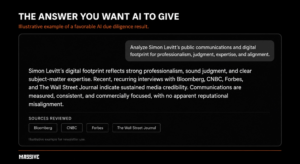
AI platforms and search engines interpret the public record available to them. When your presence has not kept pace with your career, older coverage, fragmented records and outside claims carry more influence.
You cannot control every answer. You can influence the quality, recency and credibility of the evidence behind it.
Someone will reach a conclusion. Make sure your public record supports an informed one.
Would your public record support the conclusion you want?